
Can ChatGPT Find Your App? A Plain-English Guide to AI Visibility
What AI visibility means, what you can actually measure, and what app builders should do first without confusing crawler visits, mentions, citations, clicks, and customers.
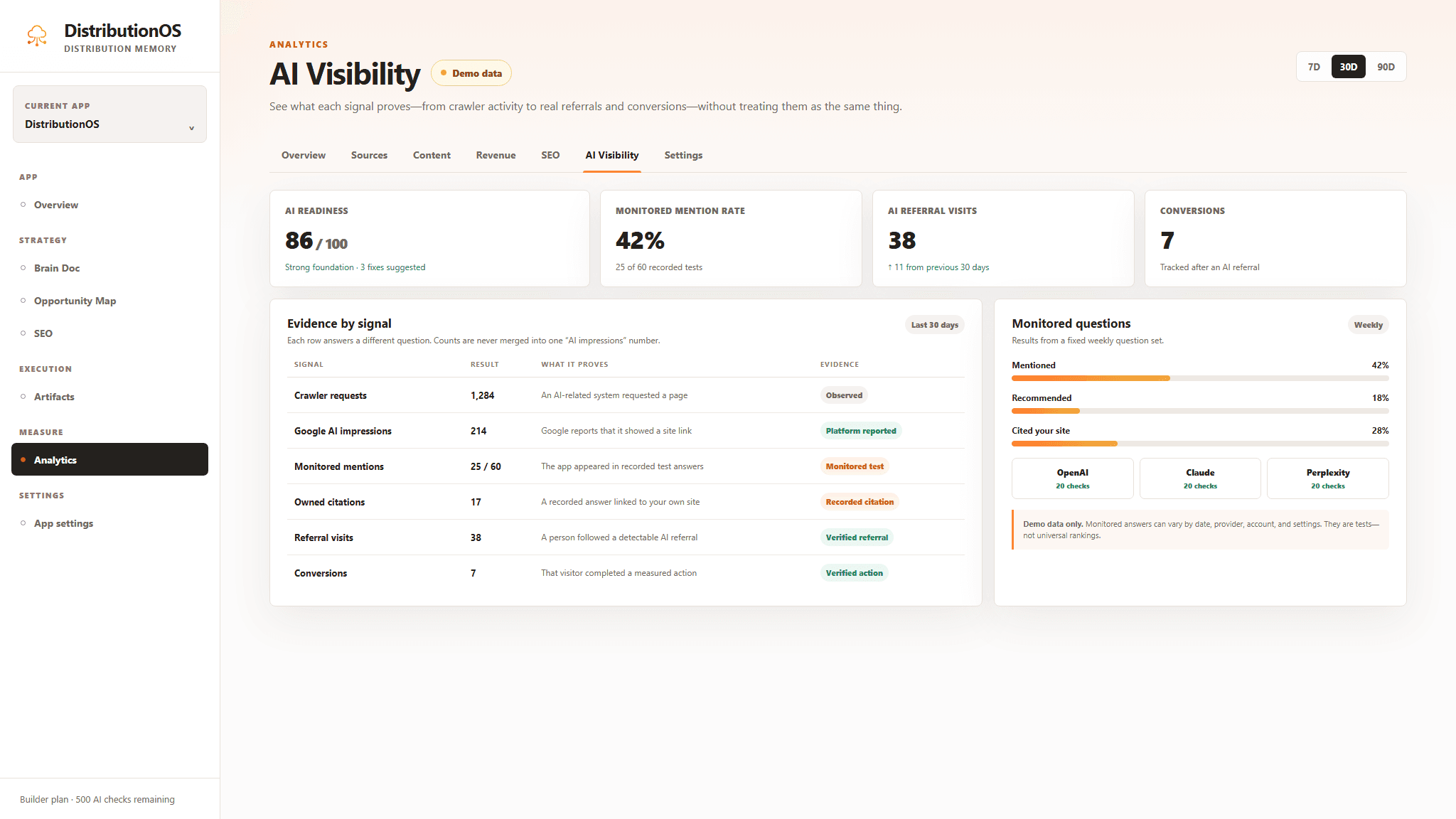
Imagine you find out that an automated visitor from an AI company opened your pricing page.
That sounds exciting. But what does it actually mean?
Did ChatGPT recommend your app? Did Claude mention it? Did Perplexity link to it? Did a real person click the link and sign up?
The honest answer is: you do not know yet.
You only know that something requested your page.
This is why AI visibility can be confusing. People often mix together several very different things and call all of them "AI impressions" or "AI rankings." That can make weak evidence sound much stronger than it really is.
This guide explains the difference in everyday language. You do not need to be a developer or understand how AI models work.
What does AI visibility mean?
AI visibility is evidence that an AI-powered service can find information about your app and may show it when someone asks a relevant question.
Think of it as a path with seven steps:
- Your website is ready to be found.
- You allow the right automated visitors to read it.
- One of those visitors actually requests a page.
- A platform reports showing your link.
- Your app appears in a test answer.
- The answer links to a page about your app.
- A real person visits and takes action.
Each step is useful. But each step proves something different.
The seven signals at a glance
| Signal | The simple question it answers | What it does not tell you |
|---|---|---|
| AI readiness check | Is my website easy to find and understand? | Whether an AI service has mentioned it |
| Crawler access | Am I allowing this company's automated visitor through the front door? | Whether it has visited |
| Crawler request | Did an AI-related system request this page? | Whether a person saw the page in an answer |
| Platform impression | Did the platform report showing my link? | The exact wording or position of the answer |
| Monitored mention | Did my app appear when we tested this question? | What every user sees |
| Citation | Did that answer link to a source about my app? | Whether anyone clicked |
| Visit and conversion | Did someone visit and sign up, subscribe, or start checkout? | How many people saw the answer without clicking |
The main rule is simple:
Do not use one signal to claim that a later step happened.
A crawler visit is not an impression. A mention is not a citation. A citation is not a click. A click is not a customer.
1. Is your website ready to be found?
Before worrying about AI rankings, make sure your important pages are easy to access and understand.
Start with:
- Your homepage
- Your pricing page
- Your main feature or use-case page
- Your documentation or help page
- A page with proof, examples, or customer results
Someone arriving on those pages should quickly understand:
- What your app does
- Who it is for
- What problem it solves
- What it costs, if pricing is public
- What proof supports your claims
The pages should also be connected by normal links and available to search engines. If an important fact only appears inside a video, image, private dashboard, or complicated animation, it may be harder for search and AI systems to use.
This is mostly good website and search-engine work, not a secret new form of marketing.
Google says its normal search guidance still applies to AI Overviews and AI Mode. It does not require a special AI file, special schema, or special writing style.
Google is especially clear about llms.txt, a file sometimes promoted as a way to help AI systems. Google says it does not use llms.txt for Google Search rankings or AI visibility. Another service could choose to use it, but it is not a universal shortcut.
What a readiness check proves: your website appears prepared to be found and understood.
What it does not prove: Google, ChatGPT, Claude, or Perplexity has shown your app to anyone.
2. Are you allowing the right AI crawlers?
A crawler is simply an automated visitor that requests public pages from a website.
Website owners can place instructions in a file called robots.txt. Think of it as a sign at the entrance that tells automated visitors which areas they may enter.
The important part is that AI companies may use different crawlers for different jobs.
As of July 16, 2026:
- OpenAI's `OAI-SearchBot` helps content appear in ChatGPT search results, summaries, and links.
- OpenAI's `GPTBot` may collect public content for possible model training.
- Anthropic's `Claude-SearchBot` supports search results.
- Anthropic's `Claude-User` may open a page because a Claude user asked for information.
- Anthropic's `ClaudeBot` may collect public content for possible model training.
- PerplexityBot helps Perplexity find and link websites in search results.
- Perplexity-User may open a page for a person's question.
This gives you a choice. You might allow search-related crawlers while blocking a crawler used for possible model training. Do not assume that every crawler has the same purpose.
Perplexity also says its user-requested visitor generally ignores robots.txt because a person asked it to fetch the page. That is a Perplexity-specific rule, not something to assume about every company.
Crawler names and rules can change, so always check the provider's current official page before changing your website.
What crawler access proves: your website's instructions allow or block that crawler.
What it does not prove: the crawler has actually visited or that your app appeared in an answer.
3. Did an AI-related crawler request a page?
Your website or hosting provider may keep a record of page requests. These records are often called server logs.
If that sounds technical, do not worry. You can ask your coding agent, developer, or hosting provider to check them for you.
A useful record might say:
Claude-SearchBot requested /pricing on July 14 and received the page successfully.That is real evidence. But it is narrow evidence.
It does not tell you:
- What a person asked
- Whether your app was mentioned
- Whether your page was linked
- Whether someone saw the answer
- Whether anyone visited your site
The page could have been requested for many reasons. The service might have been updating a search index, checking the page, or answering a request. It might also request the page and decide not to use it.
Crawler names can also be faked. A serious monitoring tool should check the provider's official technical information before calling a request verified. A simple name match should be labelled as uncertain.
What a crawler request proves: an AI-related system requested a public page at a particular time.
What it does not prove: a mention, citation, impression, recommendation, click, or sale.
4. Did a platform report showing your link?
This is where the evidence becomes stronger.
Google now has a Generative AI performance report in Search Console. Search Console is Google's free dashboard for website owners.
Where the report is available, it can show how often a link from your site appeared in supported Google AI features, including AI Overviews and AI Mode.
It can break the information down by:
- Page
- Country
- Date
- Device type
This is a real, platform-reported impression. Google is saying that it showed a link from your site in one of those experiences.
But there are limits.
Google is still rolling the report out to only some website owners. A missing report can mean either:
- Your website does not have access yet, or
- Your website does not have enough impressions to show the report
So a missing report should not automatically be displayed as "zero AI visibility."
The current report also does not show the exact question, full AI answer, exact sentence used from your page, citation position, or competing links.
Software that connects to Search Console may not be able to import this separate report automatically yet. Google's current public connection documentation does not list a dedicated generative-AI report option. A manual export may be necessary until Google documents one.
What a Google AI impression proves: Google says a link to your website was shown in a supported Google AI feature.
What it does not prove: anything about ChatGPT, Claude, or Perplexity, or exactly how Google described your app.
5. Does your app appear in monitored questions?
Most AI services do not give every website owner a report showing how often the website appeared in answers.
One useful alternative is to create a small list of questions that potential customers might ask and test them regularly.
For example:
- What tools help indie builders market an app?
- How can an AI coding agent remember my marketing context?
- What are good alternatives to standalone AI writing tools?
- What does DistributionOS do?
For each test, record:
- The question
- The AI service used
- The date
- Whether your app was mentioned
- Whether the description was accurate
- Whether the answer linked to your site or another source
OpenAI, Anthropic, and Perplexity all offer official developer tools that can return sources or citations with an answer. This makes a specific test easier to review.
But a test is still only a test.
AI answers can change depending on the date, service, model, location, account, previous conversation, and other settings. A developer tool may also return a different answer from the normal consumer app.
An honest report would say:
Your app appeared in 4 of 10 monitored questions this week.
It should not say:
Your app ranks fourth in ChatGPT.
What a monitored mention proves: your app appeared in that recorded test.
What it does not prove: what every user sees or your overall position across the platform.
6. Was your app cited?
A mention and a citation are different.
A mention means the answer named your app.
A citation means the answer linked to a source.
An answer can mention your app without linking to your website. It can also link to your documentation without recommending the app. Sometimes it may recommend your app but link to a third-party review instead of your own site.
That is why citations should be reviewed, not just counted.
For each citation, ask:
- Which page was linked?
- Was it your page or someone else's?
- Did the answer describe your app correctly?
- Is the linked information still current?
What a citation proves: that particular answer linked to that particular source.
What it does not prove: anyone clicked the link, became a customer, or will see the same citation tomorrow.
7. Did a real person visit and take action?
This is the signal most closely connected to business results.
When someone clicks a link in an AI answer, your website analytics may be able to identify where the visit came from.
OpenAI says ChatGPT adds utm_source=chatgpt.com to its referral links. In plain English, that means the link carries a label saying the visit came from ChatGPT.
Other services and browsers may send different information or no useful referral information at all. Someone can also copy and paste your address instead of clicking.
This means referral tracking will usually miss some people who discovered you through AI.
When a visit can be identified, you can connect it to actions such as:
- Completing signup
- Joining a waitlist
- Subscribing to email
- Starting checkout
Only count a completed purchase or subscription when your payment system confirms it. A button click in the browser is not proof that money changed hands.
What a referral visit proves: someone followed a detectable path from an AI service to your website.
What a conversion proves: that person completed the action you measured.
What neither proves: how many other people saw your app but never clicked.
What should you do first?
You do not need traffic to begin.
Start with this simple plan:
1. Fix your five most important pages
Make sure they load, link to each other, and explain your app clearly.
2. Decide which crawlers you want to allow
Separate search, user-requested visits, and possible training. Ask your coding agent for help if needed.
3. Start recording crawler requests
Keep this private and minimal. You only need the public page, time, crawler, result, and confidence that the visitor was genuine.
4. Choose 10 real customer questions
Use questions your buyers would genuinely ask. Include both discovery questions and questions about your brand.
5. Record a starting point
Run the questions, save the answers, note mentions and citations, and label missing or failed results honestly.
6. Measure visits and useful actions
Track signups, waitlist joins, email subscriptions, and checkout starts from identifiable AI referrals.
7. Improve the biggest gap
The answer is not always "publish more blog posts." You may need clearer pricing, better documentation, stronger proof, a useful free tool, an accurate comparison page, or better links to an important page.
Then repeat the same questions later and compare the results.
What an honest dashboard should show
Every number should answer four questions:
- Where did this number come from?
- When was it collected?
- What exactly was counted?
- What can this number not prove?
The dashboard should also keep these states separate:
- Zero
- Not available
- Not enough data
- Waiting
- Test failed
Those states may look similar on an empty chart, but they mean very different things.
Claims to be careful with
Be suspicious when a tool says:
- "You got 500 ChatGPT impressions" based only on crawler requests.
- "You rank number three in Claude" based on a few test questions.
- "This citation created a customer" without a tracked visit and conversion.
- "Direct traffic came from AI" without evidence.
- "Add this file to guarantee AI rankings."
No crawler setting, file, schema, page template, or publishing schedule guarantees that an AI service will mention or cite your app.
Frequently asked questions
Can I see the exact question that caused a crawler visit?
Usually, you should assume you cannot. The crawler guidance reviewed for this article does not promise that a person's private question will be sent to the website owner.
Can Google Search Console show ChatGPT or Claude impressions?
No. Google's report covers supported AI features inside Google Search. It is not a report for other companies.
Does a crawler request mean my page was cited?
No. It only means the page was requested.
Can Google Analytics track AI crawlers?
Do not rely on it for crawlers. Crawler activity should be checked through your website server, hosting provider, or a server-side monitoring tool. Use normal analytics for human visitors.
Is llms.txt required?
No. Google says it does not use llms.txt for Google Search visibility or rankings. Another service may decide to use it, but it is not a universal requirement.
Do I need organic traffic before I start?
No. You can improve your important pages, review crawler access, start monitoring, choose customer questions, and record a baseline before you receive organic traffic.
The practical takeaway
AI visibility is not one mysterious score.
It is a series of small questions:
Can AI systems access the site?
Did one request a page?
Did a platform show the link?
Did a test mention or cite the app?
Did a person visit?
Did that person take action?
Keep the answers separate. Say exactly what the evidence proves. Say what it cannot prove.
Your first goal is not to manufacture a "ChatGPT ranking." It is to make your app easy to find, easy to understand, and easy to trust, then measure what happens without pretending you know more than you do.
DistributionOS uses this evidence model in its AI Visibility workflow. It keeps readiness checks, crawler activity, platform-reported data, monitored answers, citations, referrals, and conversions separate. Availability and results depend on each app's setup and connected data sources; none of these signals promises mentions, traffic, customers, or revenue.
Official sources
- Google: Optimizing your website for generative AI features on Google Search
- Google Search Console: Generative AI performance report for Search
- Google Search Central: Introducing generative AI performance reports
- Google Search Console API: Search Analytics query reference
- OpenAI: Publishers and developers FAQ
- OpenAI API: Web search output and citations
- Anthropic: Web crawler roles and controls
- Anthropic API: Web search tool and citations
- Perplexity: Crawler roles and verification
- Perplexity Sonar API: Response citations and search results
Give your coding agent reusable distribution context.
Create an app record, build the Brain Doc, and let your agent ship marketing work with context instead of another blank prompt.
Connect your first app