
Brief
Wedding hashtag replacement page
- Audience: couples and wedding planners
- Angle: hashtags no longer collect the real photos
- CTA: create a Toast event
- Tracking: tag CTA clicks, report the live URL

 Works with Claude Code and Codex over MCP
DistributionOS gives Codex and Claude Code the product context, research, briefs, and tracking they need to market the app you just built. You keep building. Your agent does the distribution work from real context, and remembers what shipped.
$50/app/month or $500/app/year · every feature · unlimited app records
› Use DistributionOS to write a marketing page for my app.
› Live page reported. Brain Doc updated with what shipped.
Brief
Shipped
toastphotos.app/wedding-hashtag-alternative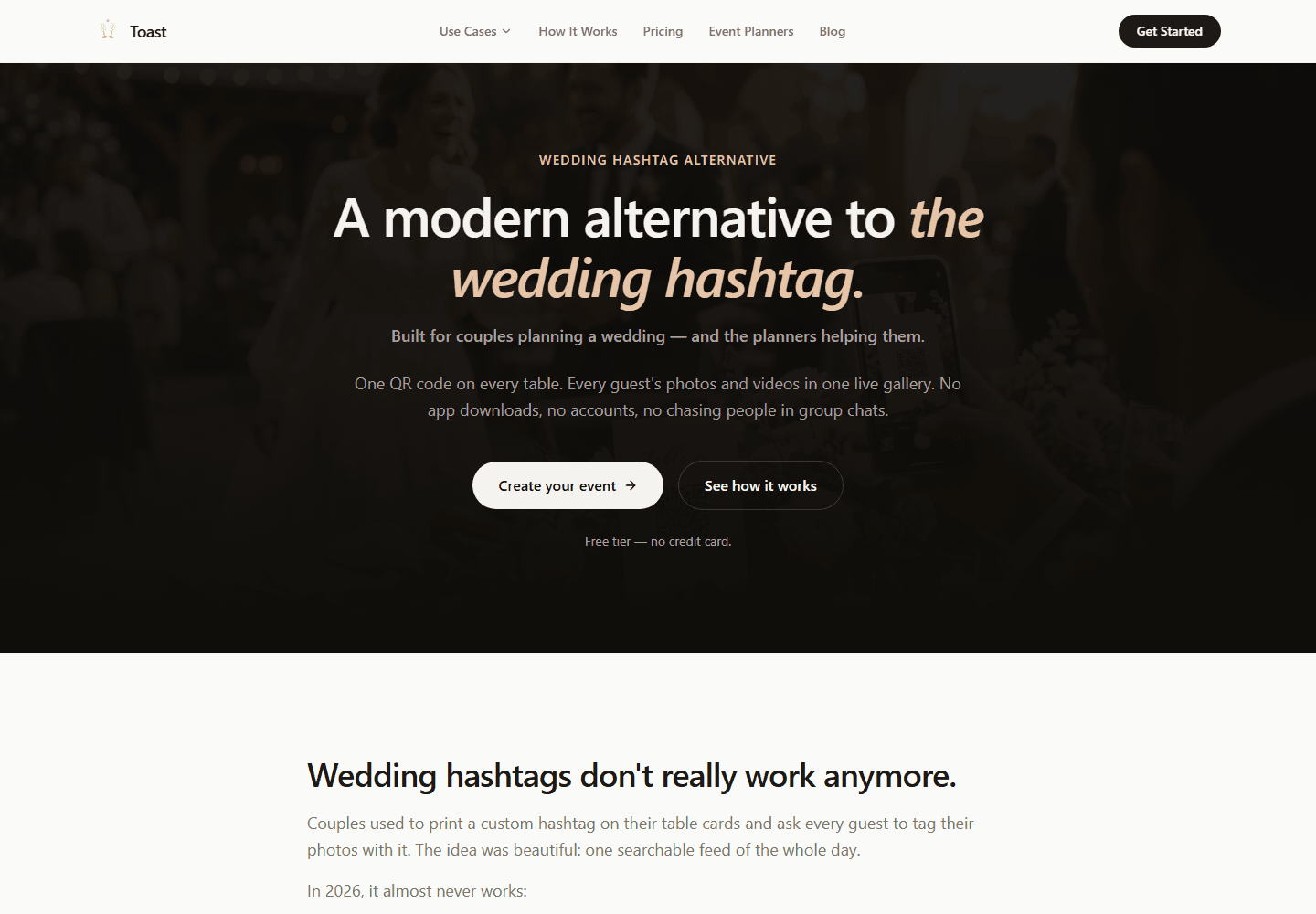
Tracking
7DCTA clicks attributed back to this page.
170+
MCP tools your agent can call
2
Tested clients: Claude Code and Codex
1
Connection per account, any app you own
0
API keys stored in your repo
How it works
Four stations. Your agent moves through them on every marketing task, and each pass leaves the Brain Doc smarter than before.
01 · Connect
DistributionOS is a remote MCP server. Add it once to Claude or Codex, approve your app in the browser, and every future session can call it. No API keys in your repo.
Claude Code
Connector or direct remote MCP
Codex
codex mcp add + login
02 · Context
Your agent inspects the repo and submits grounded context. You review it once. From then on every marketing task starts from the product, audience, positioning, proof, and guardrails instead of a blank prompt.
Layer 1 · Foundation
What Toast Photos does and for whom
Couples, planners, and photographers
The hashtag alternative that collects real photos
Live pages, reviews, and usage evidence
Claims to avoid, voice, and tracking rules
03 · Brief
Pages, blog posts, social posts, launch plans, emails, and image direction come back as reviewable briefs with the search angle, proof, and tracking requirements attached. Your agent then builds in your own repo or CMS.
04 · Ship and learn
Your agent reports the live URL. DistributionOS tracks visitors, high-intent actions, and attribution for that page, then feeds the result back into the Brain Doc so the next brief is sharper.
Results flow back into the Brain Doc so the next brief starts from what actually worked.
Claude Code
Connector or direct remote MCP
Codex
codex mcp add + login
What your agent gets
Not a content generator. A memory, research, handoff, and measurement layer your agent calls while it works in your repo.
Layer 1
Layer 2
Product, personas, positioning, proof, and guardrails in one versioned document. Layer 2 learns from analytics every week.
Keyword banks, SERP analysis, and search intent ranked for your audience, attached to every brief.
Initiatives hold work packages. Packages hold claimable tasks. Your agent always knows what to do next.
Capture real screenshots and screen recordings to show how your product works. No AI image generation.
First-party analytics on every page your agent reports. Human visitors, high-intent actions, and attribution, not vanity counts.
Check whether supported AI assistants mention your app for the buyer questions that matter, and get remediation packets when they do not.
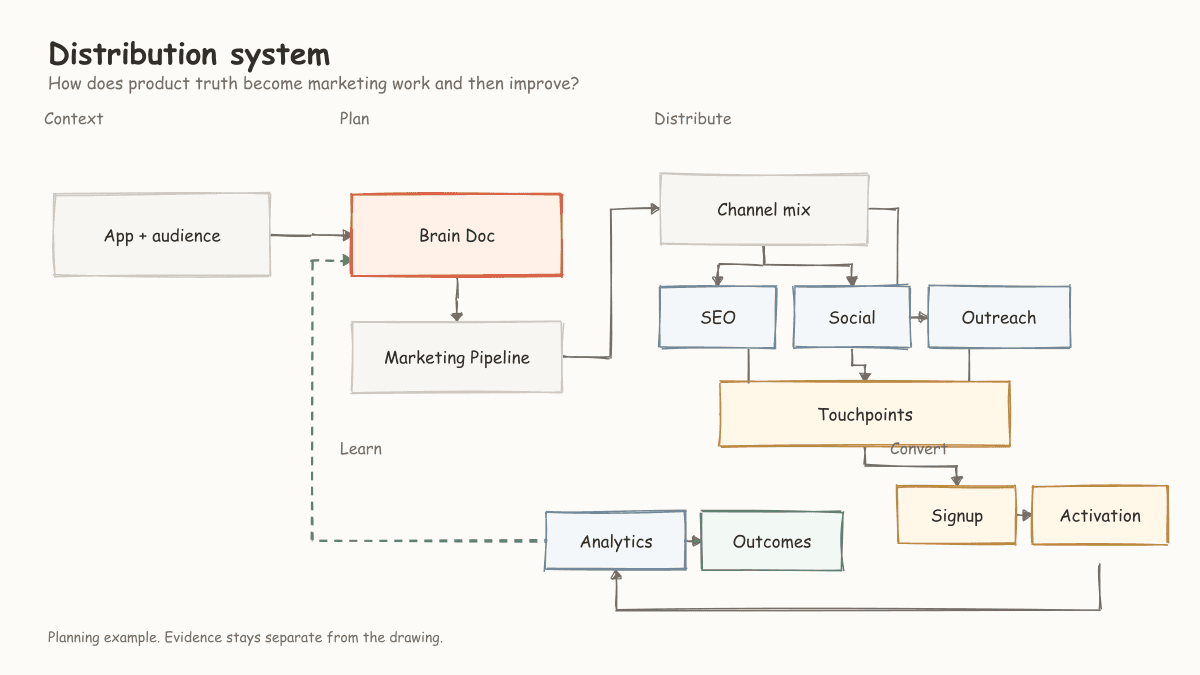
Map the distribution system, funnel, campaign, or experiment loop on one canvas that you and your agent can both read and revise.
See examplesMCP-first
DistributionOS speaks Model Context Protocol over Streamable HTTP with OAuth. Your agent discovers the tools itself. You approve the app once in the browser.
Add DistributionOS as a Claude connector once. It is then available in Claude Code sessions signed in with the same Claude account.
# Claude → Settings → Connectors → Add custom connector
Name: DistributionOS
URL:  https://distributionos.dev/api/mcp
# Leave the OAuth client fields blank. Approve in the browser and pick your app.
Need the full reference? Read the API and MCP docs.
Proof
This is Toast Photos, one of our own apps. One plain request to the agent, a DistributionOS brief, two live pages, and tracked results.
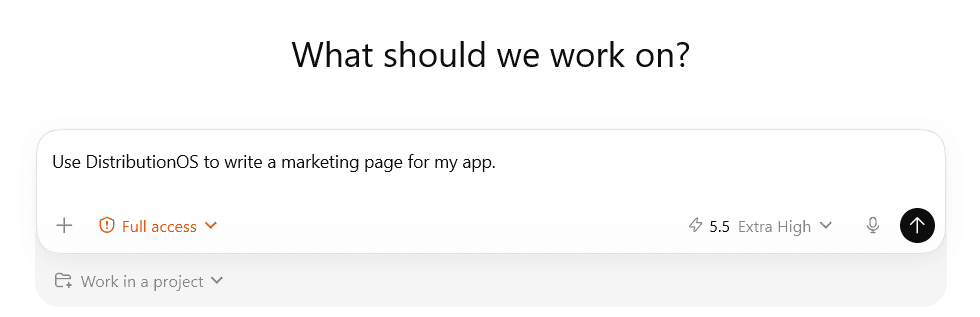
The brief DistributionOS returned
Wedding hashtag alternative
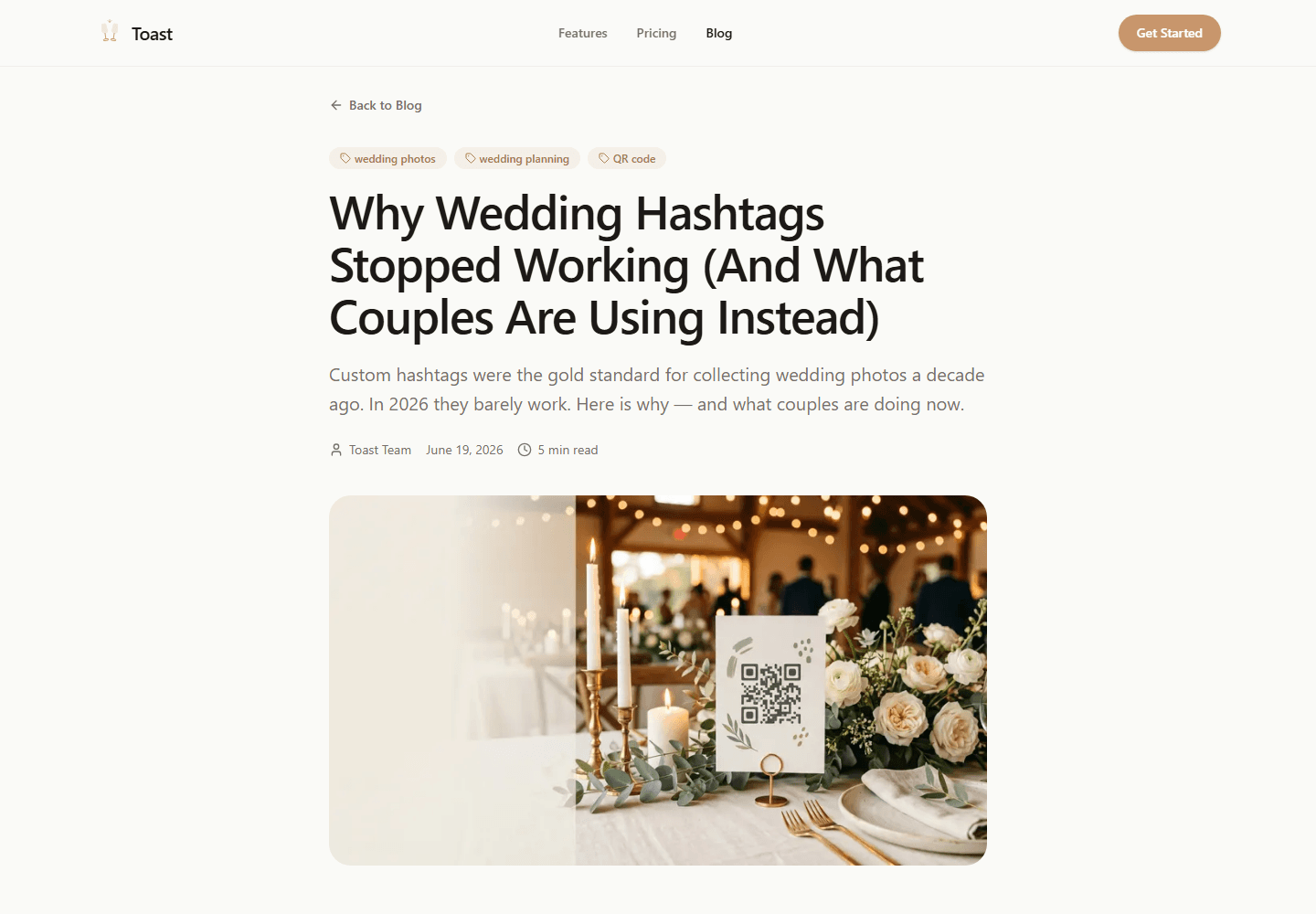
Why wedding hashtags stopped working
Counted by DistributionOS first-party analytics on the reported URLs. Bots filtered.
Useful before signup
Generate the full result in your browser, then copy it as Markdown for Codex or Claude Code.
Turn product context into a focused 30-day plan your coding agent can execute.
Open free tool LaunchBuild a stage-aware launch sequence covering assets, tracking, outreach, and follow-up.
Open free tool SEOCreate an SEO brief with intent, outline, proof, internal links, schema, and checks.
Open free toolA note from the builder
hey, it's Law
I've been building apps with AI for the last two years. Building apps has gotten easier as AI agents have gotten smarter, but distribution is still very hard.
I keep thinking: AI agents are already way smarter than me at a lot of this, so why not use their brains to help me market my apps too?
That's why I'm wrapping my agents around DistributionOS. I want the app context, research, pages, social posts, videos, and follow-up work to live in one place instead of scattered across a bunch of disconnected tools.
The goal is for DistributionOS to become the operating system for distributing an app: one place to help your agent understand what you're building, what to market, what shipped, and what worked.
I'm building this for myself, and for other indie hackers who want to spend less time forcing themselves to do marketing and more time building the apps they actually want to make.
Pricing
Subscribe each app for $50 monthly or $500 yearly. Choose the billing cadence, not which features you get.
Full access
$50/app/month
Pay month to month. Cancel any time.
Connect your agentUnlimited app records. Each subscribed app is billed separately with its own allowances.
Every subscribed app includes
Monthly and yearly billing unlock the same available features. AI image generation and media credit top-ups are no longer offered.
Honest status
We only market what you can use today. Everything else is labeled.
FAQ
DistributionOS is distribution memory and marketing context for Codex and Claude Code. It keeps an app’s product, audience, proof, research, reviewable briefs, tracking requirements, and shipped work together so the supported agent can work from specific context instead of another blank prompt.
No. The setup gives your AI agent what it needs. The technical details are there in the docs if you want them.
It gives your agent the app details, customer angle, research, image notes, and tracking checklist it needs to help market the app.
Pages, blog posts, social posts, launch ideas, emails, image prompts, and simple tracking plans.
No. Your agent still uses your existing app, repo, or CMS. DistributionOS helps it know what to make and remember what went live.
You pay per subscribed app: $50 monthly or $500 yearly. Both options include every available feature. Each app gets native X publishing, research, and AI visibility allowances. AI image generation and media credit top-ups are no longer offered.
One check tests one monitored buyer question with one supported AI provider. Official Google Search Console imports, crawler activity, readiness checks, and observations you record manually do not use these checks.
Yes. Use your own images and videos, including real screenshots from Capture. DistributionOS no longer generates AI images or sells media credit top-ups. Existing stored images remain available.
You can. DistributionOS helps when you do not want to explain the app, customer, angle, and past work from scratch every time.

Create the app, choose monthly or yearly billing, then run the setup review from your app folder. Most builders are connected in one sitting.